
 EN




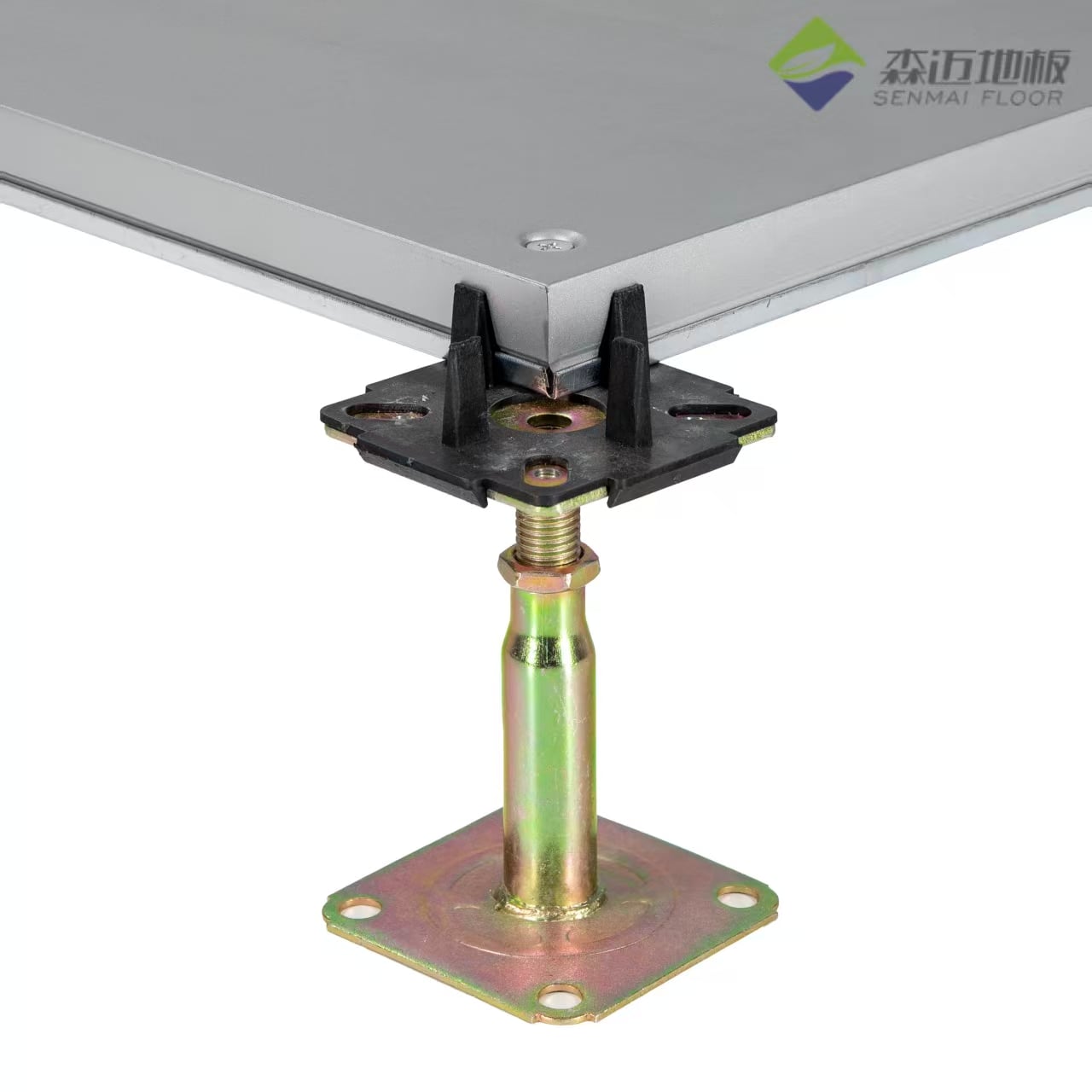
Why Access Flooring Impacts Clean Room Compliance and Performance
Access flooring is an engineered system—not merely a raised platform—that directly governs cleanroom classification. Its underfloor plenum enables precise, unidirectional airflow: HEPA-filtered air moves upward to sweep particles away from critical processing zones. Gaps, warping, or seal failure in the panel array disrupt laminar flow, creating turbulence and contaminant traps that compromise ISO 14644-1 particle counts and pressure differentials. Panel joint design must inhibit microbial growth and support rapid, residue-free decontamination.
Operational demands intensify these requirements. The floor must sustain heavy equipment, rolling carts, and frequent foot traffic without surface abrasion or micro-cracking—both of which release particulates that threaten product sterility or semiconductor yield. Chemical resistance is equally non-negotiable: exposure to sporicides, hydrogen peroxide vapor (HPV), and aggressive cleaning agents must not cause corrosion, which creates persistent contaminant reservoirs. In pharmaceutical settings, regulatory expectations explicitly mandate cleanability and resistance to microbial colonization. Materials like aluminum and phenolic-core panels are preferred for their low particle shedding and proven chemical resilience.
Electrostatic discharge (ESD) control adds another layer of engineering necessity. By embedding conductive or static-dissipative properties, the access floor provides a controlled path to ground—protecting sensitive electronics and mitigating ignition risks in solvent-rich environments.
When air management, mechanical resilience, chemical resistance, and static control are co-engineered into one system, the access floor becomes foundational to cleanroom performance. It supports validation under EU GMP Annex 1 and USP <797>, directly influencing audit readiness. An integrated system also reduces cleaning complexity and downtime, reinforcing long-term classification integrity. Crucially, it enables seamless reconfiguration and maintenance—ensuring contamination risk stays low, audits remain smooth, and operational uptime stays high.
Comparing Access Flooring Materials for Clean Room Applications
Material selection for cleanroom access flooring directly determines contamination control, particulate shedding, and chemical resistance. The optimal choice balances ISO class requirements, mechanical stress, and sterilization protocols.
Stainless Steel vs. Epoxy-Coated Steel: Durability, Non-Shedding, and Chemical Resistance
| Property | Stainless Steel | Epoxy-Coated Steel |
|---|---|---|
| Durability under heavy equipment | High – resists denting, cracking, and corrosion without a coating | Moderate – epoxy layer may crack or chip under impact, exposing steel to corrosion |
| Particle shedding | Very low – inherently non-shedding surface, no coating to flake or generate particulate | Higher risk – damaged coating can release particulate; micro‑pores may harbor contaminants |
| Chemical resistance | Excellent against acids, solvents, and CIP disinfectants | Good when intact, but compromised at edges or scratches; joint areas vulnerable |
| Cleanability | Smooth, non‑porous, withstands aggressive wipe‑downs and H₂O₂ vapor | Smooth surface but susceptible to coating delamination under aggressive cleaning |
Stainless steel access flooring panels are often specified in ISO Class 5–7 zones where frequent chemical sterilization and heavy cart traffic occur—ensuring a non-shedding platform with no coating degradation. Epoxy-coated steel can serve as a cost-effective alternative for less demanding environments, provided routine visual and integrity inspections confirm the coating remains intact and free of micro-cracks.
Phenolic-Core Panels: Rising Adoption in Pharma Grade A Suites Due to Low Particle Shedding
Phenolic-core access panels—made from resin-infused kraft paper compressed under heat and pressure—are increasingly specified for Grade A (ISO 5) pharmaceutical suites. Their homogeneous, non-porous structure virtually eliminates internal particle generation, while the surface resists moisture and common disinfectants without outgassing VOCs. Because the panel is solid throughout, even cut-outs for air diffusers do not expose a shedding core—a key advantage over composite alternatives. Typical configurations deliver consistent surface resistivity in the static-dissipative range, meeting the stringent cleanroom requirements of EU GMP Annex 1. With no metallic corrosion risk and inherent flame retardancy, phenolic-core access flooring supports long-term validation and reduces cross-contamination risk in aseptic processing areas.
Critical Engineering Specifications: Load Capacity, Sealing, and Static Control
Gasket Design and Seam Integrity for Sub-0.5 µm Particle Containment
To prevent sub-0.5 µm particles from penetrating the plenum, gasket geometry and compression must create a continuous, non-shedding barrier. Static joint designs with defined gland depths and controlled surface finishes—often below 3.2 µm Ra—allow elastomeric seals to achieve the required compression set without generating particulate debris. Material selection directly affects particle release: perfluoroelastomers offer low outgassing and high tensile strength, maintaining integrity through repeated panel removal, whereas silicone foam gaskets may deteriorate faster under chemical disinfectants. Seam integrity also depends on the tongue-and-groove interface between panels—even microscopic misalignment can form a leakage path. Some cleanrooms therefore mandate integrated, factory-bonded gaskets to eliminate on-site trimming errors. A 2023 industry survey found that facilities using pre-bonded, precision-machined gaskets reduced airborne particle spikes during floor-tile replacement by over 40% compared to field-cut seals. Regular inspection protocols—including particle counter verification at panel joints—help confirm that compression seals remain effective under operational vibration and load cycles.
Conductive vs. Static-Dissipative Access Flooring in Electrostatic-Sensitive Environments
Choosing between conductive and static-dissipative access flooring depends on process sensitivity and required charge-relaxation time. Conductive flooring (surface resistance < 1 × 10⁴ Ω) rapidly drains static charges to ground—essential in explosive-atmosphere zones where a spark could ignite vapors. However, its low resistance risks sudden discharge that damages sensitive microelectronics. Static-dissipative flooring (1 × 10⁴ Ω to 1 × 10⁹ Ω) slows electron flow, gently equalizing potential without a high-current pulse—making it the standard for semiconductor fabrication and aerospace avionics labs. Conductivity must be uniform across all panels, and grounding straps must interconnect each pedestal in a sustainable grid. Periodic verification of surface resistance using a megohmmeter—as mandated by ANSI/ESD S20.20—ensures ongoing protection for both personnel and product.
Certification, Validation, and Regulatory Alignment for Access Flooring
Strict regulatory compliance for cleanroom access flooring hinges on rigorous documentation and testing to satisfy USP <797>, EU GMP Annex 1, and ISO 14644-1. Facility teams must validate that chosen systems meet particle emission thresholds and chemical resistance demands.
Meeting USP <797>, EU GMP Annex 1, and ISO 14644-1 Through Documentation and Testing
For USP <797> compounding, access flooring must maintain ISO 5 (Class 100) conditions at critical zones, with sub-0.5 µm particle containment verified via particle counter readings and heel-batter testing. ISO 14644-1 Class 5 permits no more than 3,520 particles ≥0.5 µm per cubic meter. Properly gasketed seams reduce particulate shedding by over 60% compared to unsealed joints, according to Cleanroom Technology (2023). Full compliance requires material traceability documents, third-party load test certificates, and annual recertification audits aligned with EU GMP Annex 1’s lifecycle validation approach—ensuring sterile manufacturing integrity. These measures collectively minimize contamination risk and preserve regulatory standing.
FAQ Section
Why is access flooring important in cleanrooms?
Access flooring supports cleanroom operations by ensuring proper airflow, enabling easy cleaning, resisting chemicals, and maintaining ESD control—all crucial for contamination prevention and compliance.
What materials are recommended for cleanroom access flooring?
Stainless steel, epoxy-coated steel, and phenolic-core panels are commonly used materials, selected based on durability, chemical resistance, and ISO class requirements.
How do gaskets contribute to cleanroom flooring performance?
Gaskets prevent particle penetration into the plenum by creating a non-shedding, compressed seal. Precision-designed gaskets reduce contamination risks significantly.
What is the difference between conductive and static-dissipative flooring?
Conductive flooring quickly drains static charges and is ideal in explosive environments, whereas static-dissipative flooring gently equalizes potential without damaging sensitive electronics.
How can cleanroom flooring meet regulatory standards?
Cleanroom flooring meets standards like USP <797> and EU GMP Annex 1 through rigorous material documentation, particle control testing, and ongoing validation processes.