
 EN




Non-Porous Surface and Low VOC Emissions: Foundational Hygiene Benefits
How PVC’s Impermeable Surface Inhibits Microbial Growth and Trapped Contaminants
PVC flooring features a tightly sealed, non-porous surface that repels water, bodily fluids, and other contaminants on contact—preventing absorption into the material. Unlike porous alternatives such as carpet or untreated wood, this impermeable barrier denies bacteria, mold spores, and viruses the moisture and micro-environments they need to proliferate. Contaminants remain on the surface, where they can be efficiently removed through routine cleaning, rather than becoming embedded in microscopic crevices or subfloor cavities. In healthcare settings, for example, a PVC raised access floor in a hospital corridor prevents spills from migrating beneath the surface—preserving structural integrity and simplifying disinfection. Daily maintenance requires only a damp mop and neutral pH detergent, eliminating reliance on harsh chemicals that may leave residues or degrade surfaces over time. Crucially, PVC withstands repeated exposure to aggressive healthcare-grade disinfectants—including accelerated hydrogen peroxide and quaternary ammonium compounds—without swelling, cracking, or delaminating, ensuring long-term compliance with infection-control protocols.
Verified Low VOC Performance and Its Impact on Indoor Air Quality (GREENGUARD, FloorScore)
Volatile organic compounds (VOCs) are carbon-based chemicals that evaporate readily at room temperature, contributing to poor indoor air quality and potentially triggering respiratory irritation, headaches, and long-term health concerns. High-performance PVC flooring manufactured to stringent environmental standards emits negligible levels of VOCs. Independent third-party certifications—including GREENGUARD Gold and FloorScore—verify that products meet rigorous, health-based emission limits established by UL Solutions and the Resilient Floor Covering Institute (RFCI). These certifications are especially vital in occupied spaces like schools, hospitals, and office buildings, where occupants spend extended hours indoors. By selecting PVC flooring with verified low-VOC performance, facility managers actively reduce the total volatile pollutant load—supporting occupant well-being, productivity, and compliance with green building frameworks such as LEED v4.1 and WELL Building Standard v2.
Simplified Cleaning Protocols Reduce Cross-Contamination Risk
Efficient Dry/Wet Maintenance vs. Porous Surfaces (Carpet, Grout, Wood)
The non-porous nature of PVC fundamentally streamlines daily cleaning. Carpet fibers trap allergens, dust mites, and moisture; grout lines harbor biofilm; and unfinished wood absorbs organic soil—each requiring intensive, high-moisture interventions to achieve marginal pathogen reduction. In contrast, a smooth PVC surface enables rapid mechanical removal: dry microfiber mopping captures up to 99% of airborne particulates and surface debris, while wet cleaning with a neutral pH solution effectively dissolves light soils without prolonged dwell times or excessive moisture retention. This low-moisture, high-efficiency approach directly mitigates conditions favorable to bacterial and fungal growth—reducing both cross-contamination risk and labor-intensive re-cleaning cycles.
Reduced Reliance on Harsh Disinfectants in Sensitive Environments (Healthcare, Labs, Schools)
Because routine cleaning reliably removes organic soil—the primary nutrient source for pathogens—PVC flooring significantly lowers dependence on aggressive chemical biocides in environments where safety and air quality are paramount. In laboratories, clinical spaces, and K–12 classrooms, minimizing bleach or quaternary ammonium use protects indoor air quality, reduces staff chemical exposure, and prevents corrosion of sensitive instrumentation and finishes. When targeted disinfection is required—such as during outbreak response—the non-damageable PVC surface remains fully compatible with EPA-registered healthcare disinfectants. This balanced strategy—mechanical cleaning for daily hygiene and limited, evidence-based disinfection for critical incidents—supports the clean-to-dirty workflow principle central to CDC and WHO infection prevention guidelines.
PVC Raised Access Floor Systems for Controlled Environments
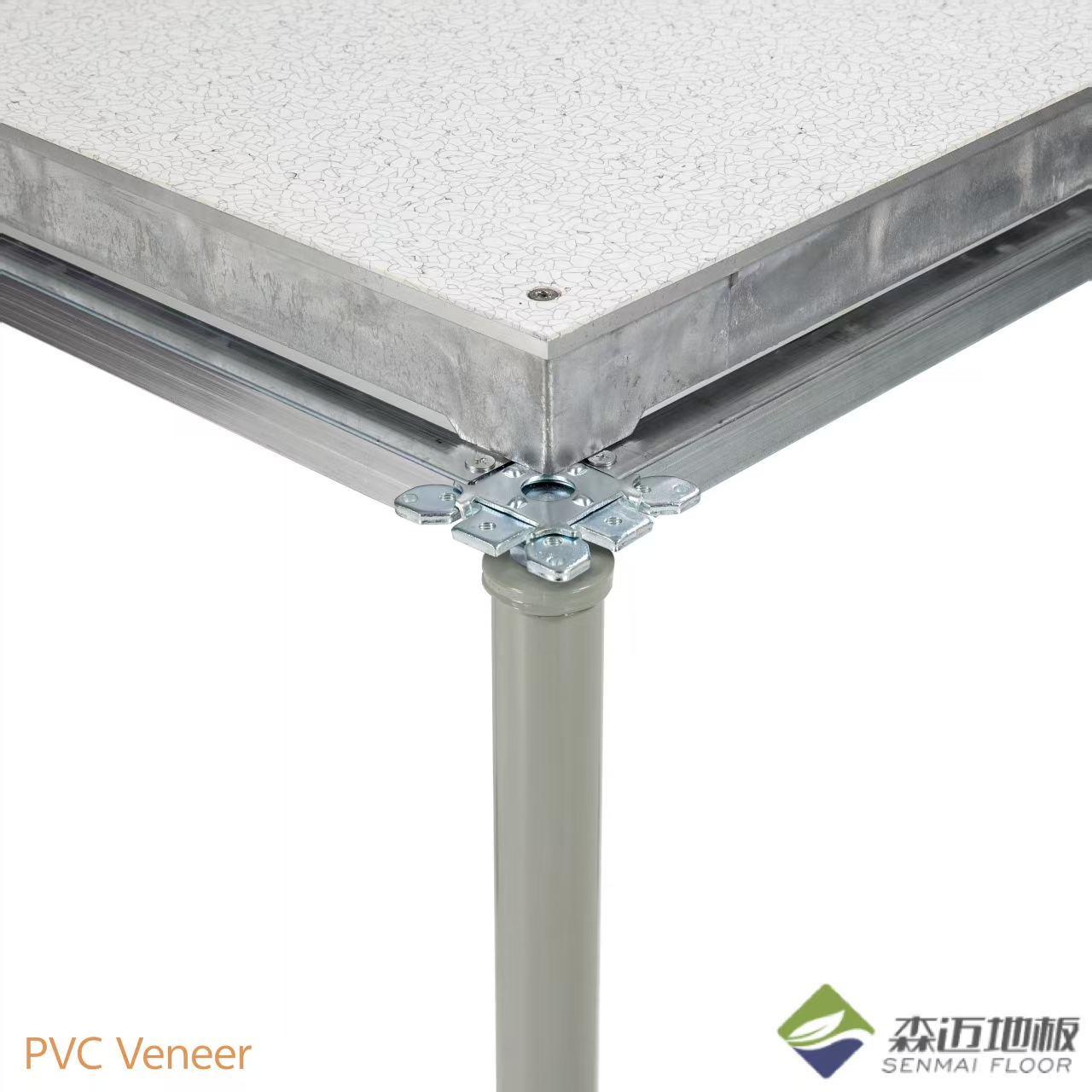
PVC raised access floor systems provide a foundational contamination-control solution for pharmaceutical manufacturing suites, semiconductor fabrication facilities, and advanced research labs. Their modular panel design allows utilities to be routed beneath the floor, eliminating overhead conduits and reducing exposed surfaces where dust and microbes can accumulate. Installation and reconfiguration occur without demolition or disruptive construction—avoiding the particle generation and porous-material contamination risks associated with traditional build-outs. This aligns directly with International Society for Pharmaceutical Engineering (ISPE) Baseline Guide recommendations, which emphasize seamless, non-shedding, and easily cleanable surfaces across all facility lifecycle phases.
Seamless Integration, Minimal Joint Lines, and Elimination of Dust Traps
High-quality PVC raised access panels can be installed with precision-tight seams and, when specified, chemically bonded or heat-welded to form a near-monolithic surface. Unlike rigid materials prone to micro-cracking under load or thermal cycling, PVC’s inherent flexibility maintains seam integrity over time—preventing the formation of microbial reservoirs and fine-particulate traps. Integrated trim profiles and grout-free edge treatments further eliminate hard-to-clean corners and recesses commonly found in carpeted, tile, or wood-core systems. The result is a validated, low-maintenance surface that reduces cleaning time and sterile wipe consumption—directly supporting ISO 14644-1 cleanroom classification requirements and U.S. Pharmacopeia (USP) <797> standards for sterile compounding environments.
ESD-Safe PVC Raised Access Floors and Particle Control in Pharma and Cleanroom Applications
In static-sensitive environments—such as aseptic filling zones and ISO Class 5 (formerly Class 100) cleanrooms—electrostatic dissipative (ESD) PVC formulations integrate conductive carbon or metal fibers uniformly throughout the panel, preserving surface smoothness and chemical resistance. These floors safely bleed static charges to ground via engineered pedestal and stringer networks, meeting ANSI/ESD S20.20 resistance specifications (1×10⁶ to 1×10⁹ Ω). Critically, the combination of zero-joint welding and ESD functionality eliminates two major sources of airborne contamination: abrasive wear from foot traffic and particle shedding from seam tapes or degraded adhesives. Validation studies conducted in active pharmaceutical production areas demonstrate that replacing conventional laminated vinyl access floors with fully sealed, ESD-rated PVC systems reduces airborne 0.5 µm particle counts by more than 60%—a measurable improvement directly tied to surface integrity and static control.
FAQs
Why is the non-porous nature of PVC flooring important?
The non-porous surface of PVC flooring prevents contaminants like water, bodily fluids, and microorganisms from being absorbed, making cleaning more effective and maintaining hygienic conditions.
What are VOCs, and how does PVC affect indoor air quality?
VOCs (Volatile Organic Compounds) are harmful chemicals that evaporate at room temperature. High-performance PVC flooring emits negligible VOCs, verified by certifications like GREENGUARD Gold and FloorScore, thereby improving indoor air quality.
How does PVC flooring reduce reliance on harsh disinfectants?
PVC’s ability to be cleaned effectively with routine maintenance eliminates organic soil that nourishes pathogens, reducing the need for harsh disinfectants and protecting sensitive environments.
What are the advantages of PVC raised access floor systems?
PVC raised access floor systems offer modularity, seamless surfaces, reduced contamination risks, and efficient cleaning to meet strict industry standards for controlled environments.
What is ESD-safe PVC flooring, and where is it valuable?
ESD-safe PVC flooring incorporates static-dissipative properties to prevent electrostatic discharge, making it essential for cleanrooms and static-sensitive environments like pharmaceutical and semiconductor facilities.